
Great prints start with the right filament. This 3D printer filament guide helps you choose materials that control strength, surface, color, and final look. A wrong pick can cause cracks or warping, while the right one makes your print clean and solid.
There are many types of filament today. PLA is easy and bright. ABS is tough and heat-safe. PETG offers strength without cracks. TPU bends without breaking. Each one works best for different needs.
This guide is for anyone who wants better prints. It helps new makers, home DIY users, and small business owners. If you sell custom parts or make models at home, this guide gives you clear answers. You also learn how to pick the best 3D printer for small business and simple tips to choose the right material every time.
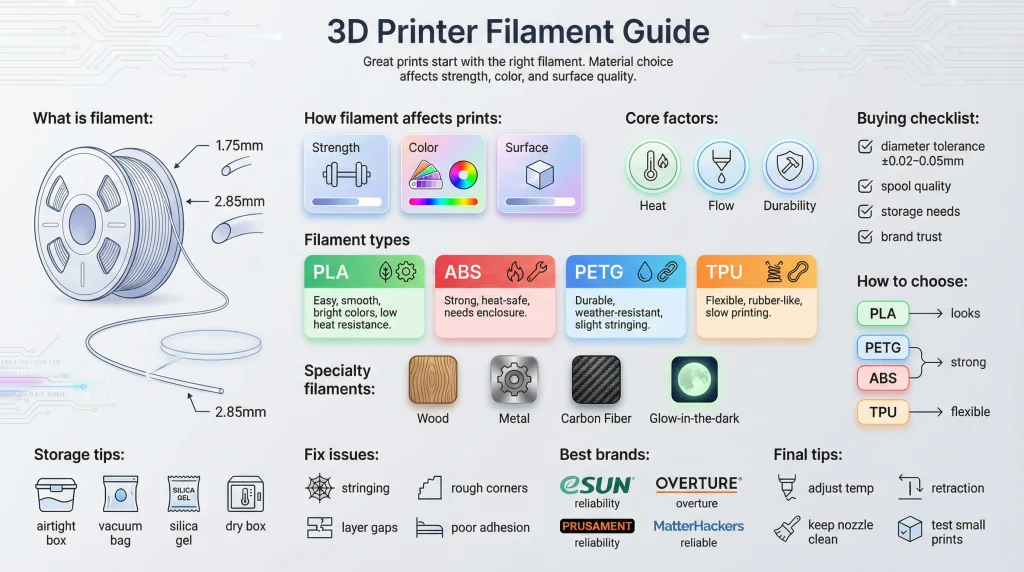
What Is 3D Printer Filament?
3D-printer filament is the plastic “ink” used to make 3D objects. It comes as a thin strand on a spool. The printer heats it and lays it in layers to form a solid part. Standard sizes are 1.75 mm and 2.85 mm. Filament choice affects how strong, colorful, and smooth your print will be.
How Filament Affects Strength, Color, and Surface
Strength: Material type and even color can change durability. Cheap or inconsistent filament can create weak spots or gaps.
Color: Pigments determine vibrancy and finish. Specialty filaments may look unique but sometimes reduce strength.
Surface: Smooth, high-quality filament creates clean layers and crisp details. A poor filament can cause prints to be rough or uneven.
Basic Factors: Heat, Flow, and Durability
Heat: Each filament melts at a specific temperature. Wrong heat causes warping or poor bonding.
Flow: Consistent extrusion ensures even layers and strong adhesion. Inconsistent flow can cause clogs or gaps.
Durability: High-quality filament resists stress, heat, and moisture. Proper storage keeps it reliable over time.
Why This Matters
The right filament improves strength, color, and finish while reducing the number of failed prints. Choosing wisely saves time, money, and frustration.
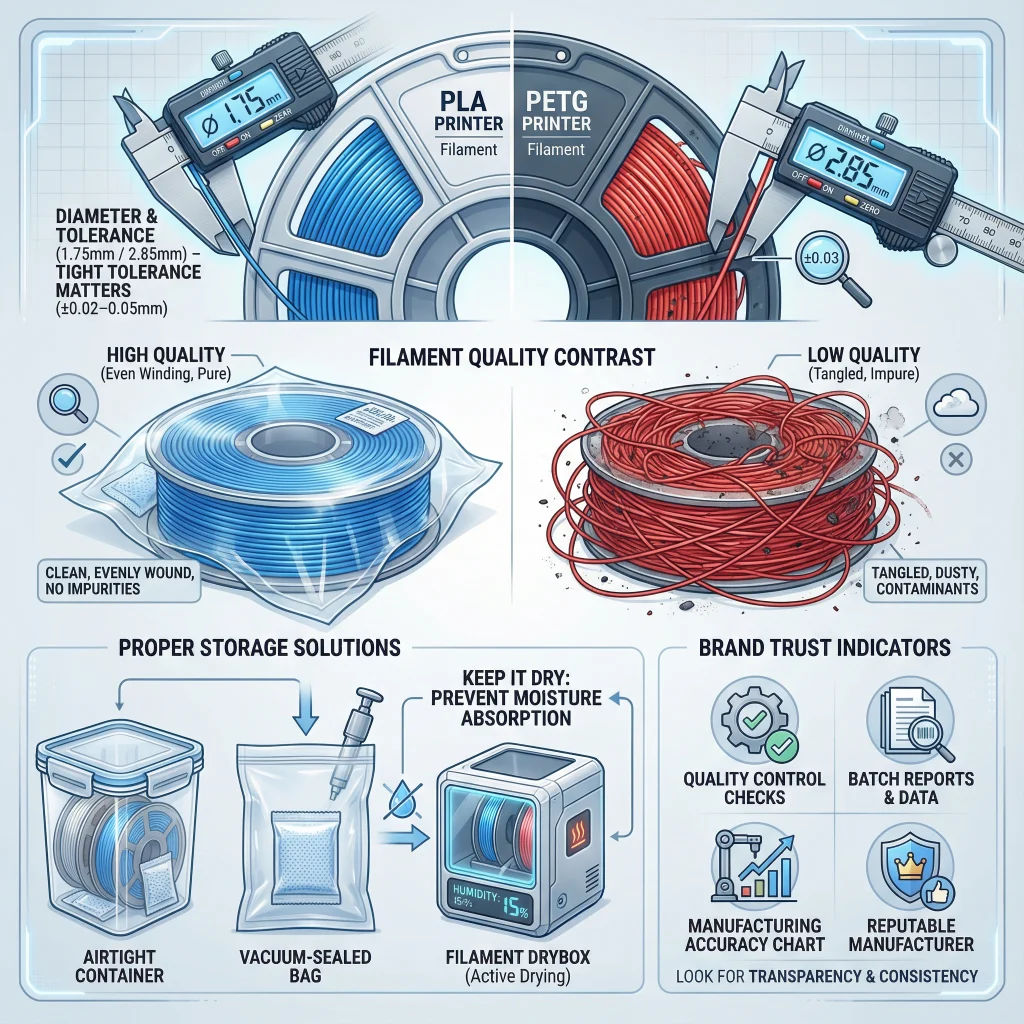
Key Things to Check Before Buying Filament
Diameter and Tolerance
When you buy filament, check the diameter. Most filaments say 1.75 mm or 2.85 mm. But the real size can vary slightly. Good filament maintains a tight tolerance, typically ±0.02 mm to ±0.05 mm. If the diameter changes too much, your printer may over-extrude or under-extrude. That can ruin layer adhesion and weaken your print. Uneven filament also affects the surface finish. Prints may have blobs, gaps, or rough layers. Always check the product page for diameter specs. Consistent filament ensures smooth extrusion and reliable print quality.
Spool Quality
Spool quality matters just as much as filament itself. A well-made spool stays round and unwinds smoothly. Cheap spools can snag or tangle, causing failed prints. Some low-cost filaments also have small dust particles or impurities that clog the nozzle. Good spools are evenly wound and clearly labeled with weight and diameter. If the brand mentions quality checks, it shows they care about filament stability. A solid spool prevents feeding problems and keeps your prints strong and clean.
Storage Needs
Filament can be sensitive to moisture and sunlight. Humid air can cause it to absorb water, leading to popping or bubbling while printing. This damages surface finish and mechanical strength. Heat and dust also degrade the filament over time. Store spools in airtight containers or vacuum-sealed bags with desiccant packs. If you print frequently, a drybox can save time and protect your filament. Proper storage keeps the filament stable and ensures smooth, reliable prints every time.
Why Brand Trust Matters
Choosing a trusted filament brand reduces risk. Reputable brands use strict manufacturing controls to ensure consistent diameter and smooth extrusion. Cheap or unknown brands may cut corners, leading to impurities, poor spool winding, and inconsistent prints. Spending a little more on quality filament saves time and frustration. Good brands may also share batch reports or spool-by-spool checks. That transparency gives confidence that your filament will remain stable and reliable.
PLA: Best Choice for Easy and Clean Prints
What Makes PLA Popular
PLA melts at a lower temperature, making it easy to print.
It rarely warps and gives smooth, clean surfaces.
This makes it a favorite for beginners and hobbyists.
Strengths: Easy to Use, Low Heat, Great Colors
- Beginner-friendly: PLA prints at low temperatures. No heated bed is often needed.
- Low odor: It emits almost no odor, making it safe for home use.
- Beautiful colors: You can get bright, metallic, wood-like, or glow-in-the-dark finishes.
- Fine detail: PLA produces sharp lines, making it perfect for models and decorations.
PLA is an eco-friendly filament and very beginner-friendly.
Weaknesses: Not Ideal for Hot Places
- Low heat resistance: PLA can soften in warm places.
- Brittle under stress: It can break if bent or twisted too much.
- Not for functional parts: Avoid using it for handles, tools, or hot objects.
Best Uses: Toys, Decor, Models
PLA works well for:
- Figurines and toys
- Decorative items
- Display models and prototypes
ABS: Tough Filament for Stronger Parts
Simple Explanation
ABS is a strong, classic plastic.
It can handle heat and stress better than PLA.
Strengths: Strong, Heat-Resistant
- Durable: ABS bends slightly before breaking.
- Heat-resistant: Great for parts that get warm.
- Post-processing friendly: Sanding or smoothing with acetone gives polished results.
Weaknesses: Smell, Warping
- Odor: ABS emits strong fumes. Print in a ventilated area.
- Warping: It may shrink or crack if it cools unevenly.
- Not beginner-friendly: ABS needs careful settings and sometimes an enclosure.
When to Use ABS
Choose ABS for:
- Strong, impact-resistant parts
- Mechanical parts or housings
- Functional pieces that may get hot
Safety Tips
- Always print in a well-ventilated room.
- Use a heated bed and enclosure to reduce warping.
- Take your time to calibrate printer settings carefully.
ABS is great for durable prints and heat-safe parts.
PETG: A Balance of Strength and Flexibility
Why Many Users Pick PETG
PETG mixes the best of PLA and ABS.
It is easier to print than ABS but stronger than PLA.
It also resists warping and moisture well.
Strengths and Limits
- Strong and durable: PETG withstands stress and some bending.
- Heat and weather-resistant: It works better outdoors or in humid areas.
- Low warping: Prints stick well and shrink less than ABS.
Watch out for:
- Slight stringing or blobs if settings are off
- Needs heated bed for best results
- Surface can scratch more easily than ABS
Good Uses: Functional Parts, Outdoor Items
PETG is perfect for:
- Mechanical parts and enclosures
- Storage boxes or containers
- Outdoor gear or weather-exposed items
- Medium-strength functional objects
PETG gives crack-free prints and weather-safe filament performance.
TPU: Flexible Filament for Soft and Bendable Prints
Simple Definition
TPU is soft and flexible.
It works more like rubber than hard plastic.
What Makes TPU Bend
Its material stretches and bends without breaking.
Perfect for items that need to flex or absorb impact.
When to Pick TPU
Use TPU for:
- Flexible parts like phone cases, shoe soles, or hinges
- Items that need repeated bending
- Soft or wearable 3D prints
Tips for Smooth Prints with TPU
- Print slowly: Too fast may distort the print.
- Good bed adhesion: A slightly heated bed helps prevent warping.
- Adjust retraction: TPU can string easily if the settings are off.
- Start small: Test settings on tiny prints first.
TPU is a flexible 3D material and feels like a rubber-like filament.
Comparison Table for 3D Printer Filament Guide
| Feature | PLA | ABS | PETG | TPU |
|---|---|---|---|---|
| Print Difficulty | Very easy; great for beginners | Harder; needs tuning and enclosure | Moderate; easier than ABS | Hard; requires slow speed |
| Heat Resistance | Low; softens in warm areas | High; handles heat well | Medium; better than PLA | Low–Medium; depends on blend |
| Strength | Moderate; can be brittle | Strong and impact-resistant | Strong and flexible | Very flexible and durable |
| Flexibility | Low; rigid | Low–Medium | Medium; slight bend | Very high; rubber-like |
| Warping Risk | Very low | High | Low | Low |
| Odor During Printing | Almost none | Strong fumes; needs ventilation | Low | Low |
| Finish Quality | Smooth with fine detail | Matte; can be polished | Smooth; may string | Soft, rubber-like |
| Best For | Toys, decor, models | Heat-safe parts, housings, mechanical pieces | Outdoor items, containers, functional parts | Phone cases, hinges, wearable items |
| Special Notes | Eco-friendly; huge color range | Needs heated bed + enclosure | Weather-resistant; strong adhesion | Print slowly; adjust retraction |
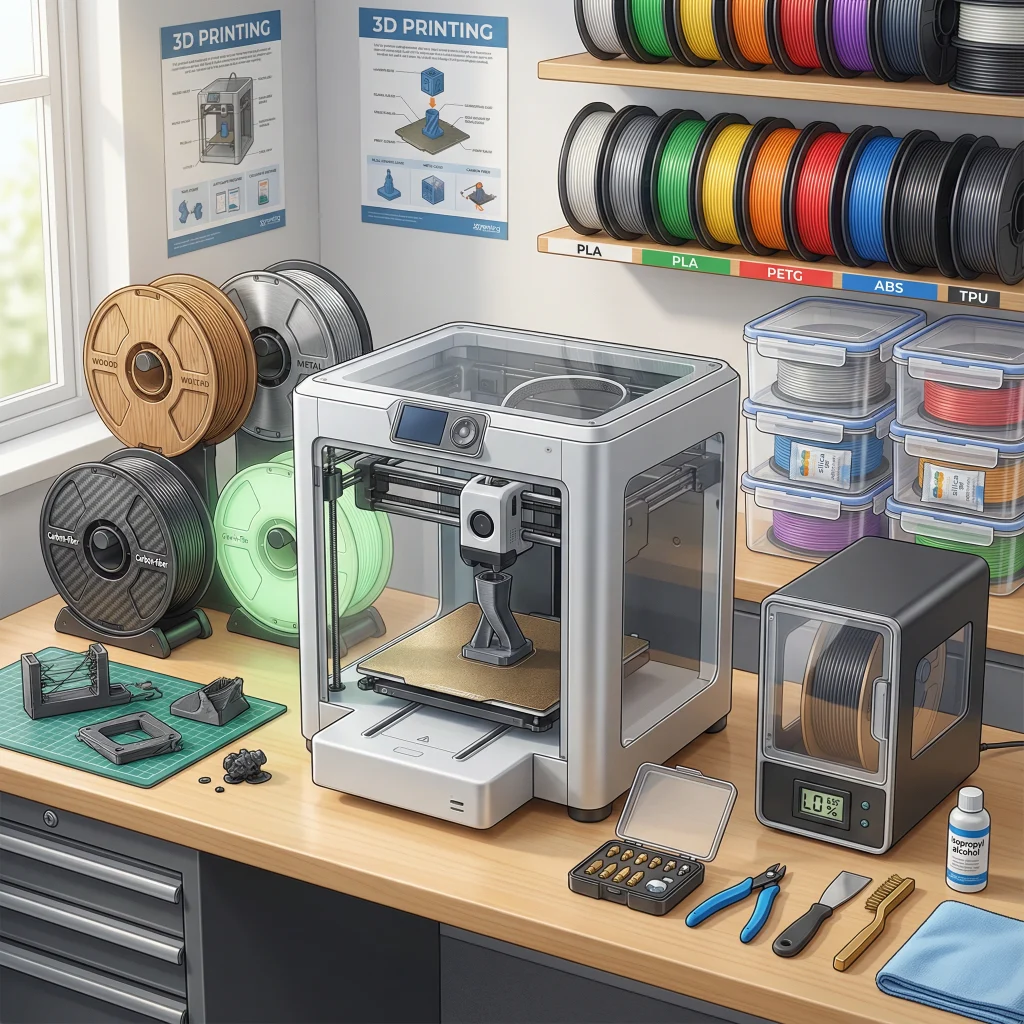
Specialty Filaments (Simple Overview)
Specialty filaments let you print more than standard plastic parts. They give your projects unique looks, textures, and functions. Common types include wood‑filled, metal‑filled, carbon fiber, and glow‑in‑the‑dark filaments. Each adds style or strength but can be trickier to print.
Wood‑filled filament mixes plastic with fine wood fibers. Prints look and feel like real wood. It’s great for decorative items, props, or signs. Watch out: it can clog small nozzles and reduce strength slightly. Printing slower with a nozzle ≥0.4 mm works best.
Metal‑filled filaments mix plastic with metal powders like bronze or copper. They make prints heavier and more solid. Use them for statues, desk items, or weighty decorative parts. They’re abrasive, so use a hardened nozzle and slow printing speeds.
Carbon fiber filaments include tiny fibers to strengthen prints. They are ideal for brackets, functional parts, or any application that requires rigidity. These filaments wear out standard nozzles, so use a hardened nozzle and a slightly larger diameter.
Glow‑in‑the‑dark filaments have phosphorescent pigments. They glow after exposure to light, perfect for toys, night lights, or creative prints. Like other specialty filaments, they can be abrasive and may affect layer adhesion if not printed carefully.
Use specialty filaments when you want “premium filament” and “creative printing materials.” Each type has benefits, but expect slower printing, nozzle wear, and possible surface imperfections.
How to Store Your Filament the Right Way
Proper storage keeps your filament dry and ready for perfect prints. Many filaments, like PETG, Nylon, and TPU, absorb moisture from the air. Wet filament creates bubbles, stringing, poor layer adhesion, and rough surfaces.
Store filament in airtight containers, vacuum bags, or specialized dry boxes. Include silica gel or other desiccants to absorb moisture. Keep spools in cool, dry places, away from sunlight and heat. Original packaging works well if it’s sealed with desiccant.
Signs your filament absorbed water include popping or crackling sounds, stringing, uneven surfaces, weak layers, and nozzle clogs. Dry your filament before printing if you notice these problems.
How to Fix Common Filament Issues
Even with high-quality, dry filament, problems can still occur. Here’s how to fix them:
Stringing: Thin threads appear between parts. Reduce the nozzle temperature, increase the retraction, and ensure the filament is dry.
Layer gaps: Layers don’t stick properly. Slow the print, slightly raise the temperature, and check bed adhesion. Dry filament also helps.
Rough corners: Edges or surfaces look uneven. Slow printing, use the proper nozzle, and dry filament. For metal or fiber-filled filaments, hardened nozzles help.
Poor sticking: Parts lift from the bed. Clean the bed, adjust the temperature, use adhesive aids, and ensure the filament is dry.
Best Filament Brands in the USA (Simple Overview)
Choosing a reliable filament brand makes a big difference in print quality. Some trusted U.S. options include eSUN, OVERTURE, Prusament, and MatterHackers. Good brands offer consistent diameter, smooth extrusion, and strong customer support. Their spools are usually well-wound and color-consistent, reducing the risk of failed prints.
Be careful with very cheap or poorly packaged filament. Signs of low-quality spools include knots, uneven winding, unclear specifications, or reports of frequent clogs. Even trusted brands can occasionally have bad spools, so always check before starting a big print.
How to Choose the Right Filament for Your Project
The right filament depends on your project’s needs. PLA is perfect for decorative models and prototypes. PETG or ABS works better for strong, heat-resistant parts. For flexible items like phone cases, TPU is the best choice.
Think about strength, looks, and flexibility. PLA looks clean but is brittle. ABS and PETG are stronger but need higher print temperatures. TPU bends easily but may sacrifice rigidity. Also, consider heat exposure, environment, and your budget. Choosing wisely prevents wasted time and material.
Final Tips for Perfect Prints
Small tweaks make a big difference. Adjust print temperature to avoid stringing or weak layers. Set retraction properly to reduce blobs. Keep your nozzle and bed clean for smooth adhesion. Run small test prints before big jobs. Finally, take notes on settings and results to improve your prints over time.
Practical & Straightforward
Your filament choice directly affects your 3D print results. PLA is easy to use and comes in bright colors. ABS and PETG are strong and handle heat well. TPU is flexible, perfect for parts that need bending. Think about what your project needs—strength, flexibility, or heat resistance. Using the right filament with proper printer settings prevents warping, stringing, and weak prints. A bit of planning saves time, material, and frustration. Pick wisely, and your prints will be smooth, reliable, and professional every time.
FAQs — Ultimate 3D Printer Filament Guide for Perfect Prints
What is 3D printer filament and why is it important?
Filament is the material your 3D printer uses to build objects layer by layer. It can be plastic, flexible, or specialty material. The type you choose affects strength, flexibility, surface finish, and durability. Picking the right filament ensures your project works and looks exactly as intended, whether it’s a decorative model or a functional part.
Which filament is best for beginners?
PLA is the easiest choice for beginners. It melts at low temperatures and sticks well to the bed. PLA prints smoothly, rarely warps, and comes in many colors. Beginners can create clean, attractive prints without worrying about complex settings. It’s perfect for toys, models, and decorative items.
I want strong or functional parts. Which filament should I use?
PETG and ABS are best for strength and durability. PETG offers toughness with some flexibility, making it great for mechanical parts or outdoor objects. ABS is stronger and heat-resistant, ideal for housings or automotive components. ABS can warp and produce fumes, so a heated bed and proper ventilation are needed.
What filament should I use for flexible or rubber-like prints?
TPU is perfect for flexible, elastic prints. It works well for phone cases, gaskets, wearable items, or any part that bends. Printing TPU requires slower speeds and sometimes a direct-drive extruder. With proper setup, TPU produces strong, flexible parts that hold up under use.
How do I choose the right filament for my project?
Match the filament to the project’s needs. Use PLA for decorative or detailed models, PETG or ABS for durable or heat-resistant parts, and TPU for flexible parts. Also consider environmental factors like heat, outdoor exposure, or mechanical stress. Choosing the right filament ensures both print quality and performance.